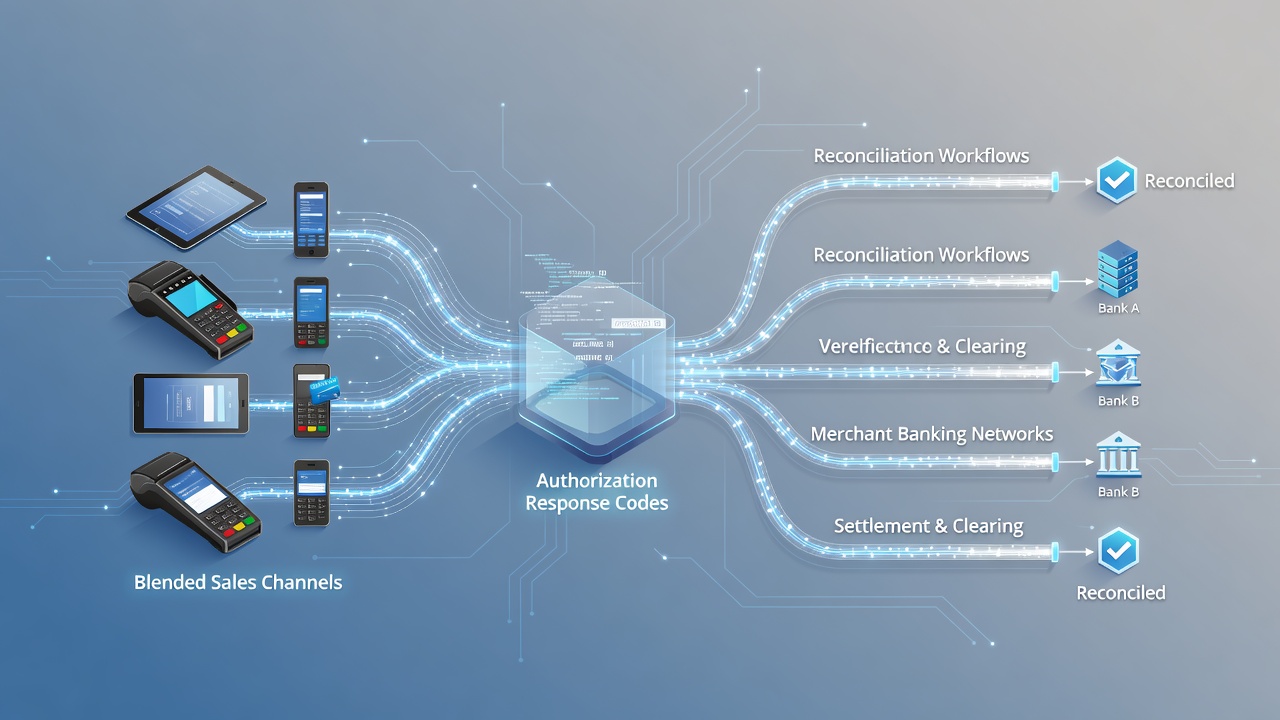
How Authorization Response Codes Guide Reconciliation Workflows in Blended Merchant Banking Networks
Authorization response codes form the backbone of transaction validation across merchant banking networks, and they directly influence how reconciliation workflows unfold in blended sales channels that combine in-store terminals with online gateways. These codes, ranging from standard approvals to specific decline reasons such as insufficient funds or suspected fraud, travel through acquirers, card networks, and issuers before returning to the merchant's systems, where they trigger downstream settlement and matching processes. In environments where point-of-sale devices operate alongside digital storefronts, the timing and detail within each code determine whether a transaction enters the clearing queue immediately or requires manual review during batch settlement.
Core Mechanics of Response Codes in Multi-Channel Flows
Each authorization attempt generates a standardized code set by the card networks, and these codes carry embedded instructions that shape subsequent reconciliation steps. An approval code initiates automatic inclusion in the merchant's daily batch, whereas a code indicating referral to the issuer often routes the record into a pending queue that reconciliation teams must resolve before the settlement window closes. Blended operations see these pathways intersect when a single customer account triggers both a physical terminal swipe and a separate online authorization within minutes, creating duplicate or offset entries that systems must align using timestamp and code data. Observers note that networks process millions of such mixed-channel transactions daily, with code variations dictating whether funds move through standard clearing cycles or enter exception handling.
Research from the Federal Reserve Bank of New York indicates that response code granularity has increased in recent years, allowing acquirers to apply more precise filters during reconciliation. When a decline code for velocity checks appears on an online order that follows a successful in-store authorization, the combined dataset prompts automated alerts that prevent double-counting in financial reports. This mechanism becomes especially visible during high-volume periods when inventory systems linked to payment platforms adjust stock levels based on confirmed rather than attempted sales.
Impact on Settlement Timing and Exception Management
Settlement batches in acquiring banks rely on aggregated authorization data, and response codes determine which records advance to the next stage without intervention. Codes that signal partial approval, common in blended scenarios where available credit covers only part of a combined in-store and online purchase, require splitting the transaction record before it reaches the processor's reconciliation engine. Data shows that such splits occur more frequently in retail chains operating both channels, where a single authorization sequence may span multiple merchant IDs. Teams responsible for matching incoming deposits against original requests use these code distinctions to flag discrepancies early, reducing the volume of items that reach the end-of-month closeout unresolved.
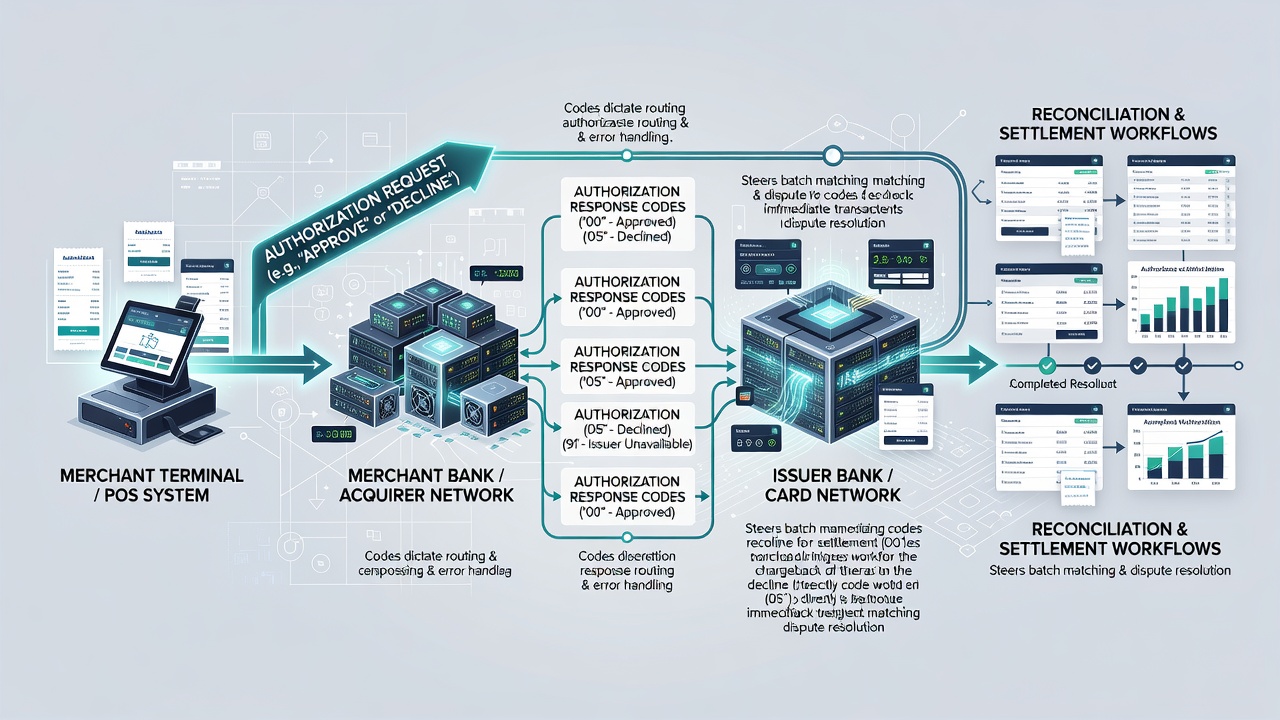
By August 2026, updates to network rules had expanded the set of conditional codes available for cross-channel transactions, enabling finer control over how partial or conditional approvals flow into clearing. Acquirers adopted these changes to tighten matching logic between terminal logs and gateway records, and industry reports note corresponding drops in manual intervention rates for merchants running unified commerce platforms. The European Central Bank has documented similar shifts in its oversight of payment systems, highlighting how code-driven routing supports accurate daily netting across borders for retailers with mixed sales models.
Integration with Inventory and Financial Reporting Systems
Authorization codes feed directly into reconciliation software that cross-references payment outcomes against order management databases, and this linkage proves critical in blended environments where a declined online authorization may still leave an in-store record active. Systems parse the codes to decide whether to release inventory holds or trigger restocking signals, preventing overcommitment of goods that never clear financial review. One study of North American acquirers revealed that merchants incorporating code-level logic into their reconciliation routines achieved tighter alignment between reported sales and actual settled amounts, particularly when tracking multi-channel returns that reference the original authorization sequence.
What's notable is how specific decline subcodes, such as those denoting address verification failures, steer records into separate reconciliation tracks that interface with fraud monitoring layers. These tracks operate independently of standard settlement cycles yet must reconcile at the batch level, creating layered workflows that acquirers manage through dedicated exception files. Canadian payment associations have tracked the adoption of such layered approaches, noting measurable improvements in reporting accuracy for retailers that synchronize POS and e-commerce data streams using code-driven rules.
Conclusion
Authorization response codes continue to shape the operational backbone of reconciliation across merchant banking networks serving blended sales channels. Their structured transmission from issuer through acquirer to merchant systems dictates which transactions proceed to settlement, which enter exception queues, and how inventory and financial records stay synchronized. As networks refine code sets and regional oversight bodies publish updated guidelines, the precision of these workflows supports consistent matching between authorization events and final deposits, regardless of whether the original request originated at a countertop terminal or through a digital gateway.